There has been a long way to go with hybrid vehicles. What has been merely experimental technology is now parked in driveways the world over, silently sucking fuel as their owners are a little less worried about their carbon footprint. However, behind that clean and efficient exterior lies one of the most electrically complicated systems ever stuffed into a consumer product and that complicatedness comes with its own set of vulnerabilities.
Hybrid power systems wiring failures are not necessarily dramatic. Sometimes it’s a sudden warning light. At times it can be a slow decline in performance that cannot be attributed to any obvious cause. And occasionally, when things go that way, it is a safety hazard. Knowing what it is exactly that leads to these failures can not only save you money, but can also lengthen the life of your automobile, and make you pose the right questions when things are going wrong.
In This Article:
The Dual-Voltage Problem Nobody Talks About
This is what is really difficult in hybrid wiring: these systems do not use one voltage. Using a 12-volt network to provide you with lights, infotainment, and accessories, it has got a high-voltage system, usually between 200 and 650 volts, to supply the electric motor and charge your battery pack.
The two worlds must share the same vehicle, but engineering and fine insulation have to keep them apart. Once that separation fails, even a little, you are dealing with possible shorts, ground faults or even worse. The margin of error is low and the outcome of the failure is high.
Thermal Stress: Heat Is a Slow Killer
Heat is probably the single enemy that has appeared in nearly all the wiring failures stories. Hybrid drivetrains produce a lot of thermal power – the one that is produced by the combustion engine and that which is produced by the battery management system. Wiring that is installed around the heat related sources or in the narrow capacity with little air circulation always experiences stress.
The insulation materials wear out with time. They break, snap and later cannot withstand the resulting conductors. This type of failure does not occur in one day. Slowly increasing with age, distance, it is difficult to notice, this is why thermal damage is usually underestimated until the symptoms become difficult to ignore.
This is exactly why high-quality Cable Assembly matters so much in hybrid applications:
- The choice of materials to use in insulation.
- Connectors heat rating.
- The routing method of the assembly through the car.
All these directly affect the duration of the wiring in the real world environment.
Vibration and Movements: The Physical Part of Failure
A running vehicle is a constantly vibrating vehicle. Each bump, acceleration, and difficult halt causes mechanical stress on all parts – such as wiring.
- Connectors loosen: Constant movement can back out secure fittings.
- Fatigue: Wires bend until the internal conductor gets weary and ruptures.
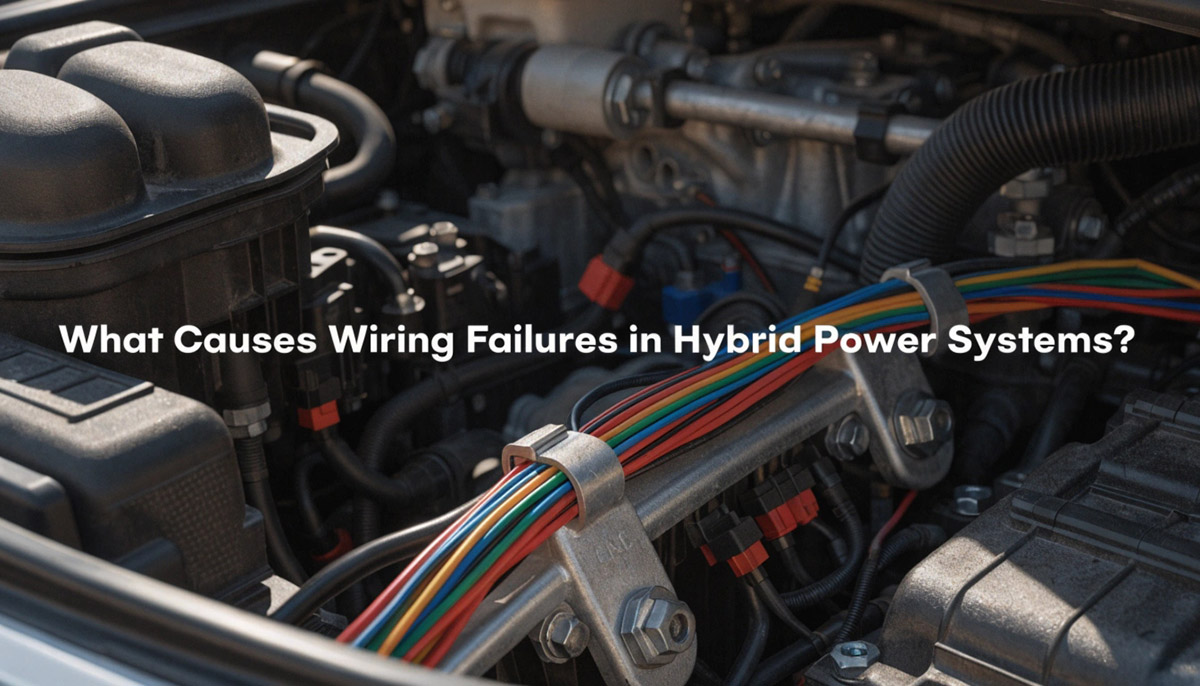
- Abrasions: Harnesses are held in place by clips which may crack or move allowing wires to rub against metal edges that cut through the insulation over a period.
This type of damage occurs particularly frequently at mounting points, and at any place where a wire must bend around a corner or squeeze through narrow clearances. Simply, by having longer and more complex wire runs in a hybrid system than in a conventional vehicle, vibration-related wear has more chances to occur in hybrid systems.
Moisture and Corrosion: A Relentless Threat
It is no secret that water and electricity are not compatible. However, how moisture finds its way into a hybrid wiring system can be very insidious:
- The condensation in connector housings.
- Sprays on the road extending to the parts of the road that were not intended to be well covered.
- Wash water that has made it through a grommet that is not fitted correctly.
If moisture makes its way into a connector, corrosion builds up on the terminal contacts. Undesirable contacts lead to higher electrical resistance. Therefore, switching failures are quite varied from one failure to another and often catch the technician off guard. ErrorCode descriptions are usually a shot in the dark. Sometimes, it’s frustrating, as resolving corrosion-related problems typically makes an accurate diagnosis when oftentimes the suspected fault is supposed to be a malfunctioning software component or simple sensor failure — not actually a corrosion-encrusted pin hidden deep in a connector.
Assembly Variability and Manufacturing

Wear and tear are not the root causes of all the wiring issues. Some start at the factory. The Automotive Wiring Harness in a hybrid vehicle is a highly engineered component, but its quality is only as good as the processes and materials used to produce it.
Common manufacturing-related issues include:
- A connector that was not completely fit during assembly.
- One of the terminals that were crimped a little out of spec.
- Part of the harness which was not properly secured prior to the vehicle going off the line.
They are not necessarily the ordinary failures, but they do occur and when they occur they are frustratingly hard to diagnose since everything seems right on the surface.
Software and System Complexity Add a Layer of Risk
Hybrid systems of today are highly software-reliant. All communication is via the wiring through data networks that interconnect the battery management system, the power control unit, and the regenerative braking system. Failure in any single connection in such a network does not just impact that single component but can cause cascading failures in a host of systems.
This electrical/software integration implies that the wiring failures in hybrids tend to manifest themselves as incomprehensible error codes or intermittent faults that appear and disappear without any apparent reason. A loose data line connector may appear like a control module problem.
What You Can Really Do About It
It is a good place to start with awareness. It is not only the battery that is worth checking, but also the wiring and connectors in the high-voltage system of your hybrid, which should be periodically inspected, particularly in older or vehicles which have been kept in harsh climates.
Warning Signs to Watch For:
- Intermittent warning lights.
- Fuel economy decreases without any apparent reason.
- The hybrid system started to act strangely.
When these occur, do not imagine that this can be explained by a software glitch. Inquire directly on connector condition, insulation integrity, and whether there is heat damage or moisture intrusion. Even when the electrical system of your vehicle is undergoing repair, be certain that the person doing it knows the unique requirements of hybrid wiring since there is no such thing as standard automotive electrical wiring and high-voltage hybrid wiring.
Wrapping Up
Failures in the electrical systems of hybrid vehicles are not random, but rather are based on patterns; heat, vibration, moisture, and manufacturing variance are responsible. Understanding these patterns will facilitate their early identification.
Hybrid cars are amazingly engineered, but all engineering cannot eliminate effects of time and use. Being informed and staying proactive are the best defense you have.