
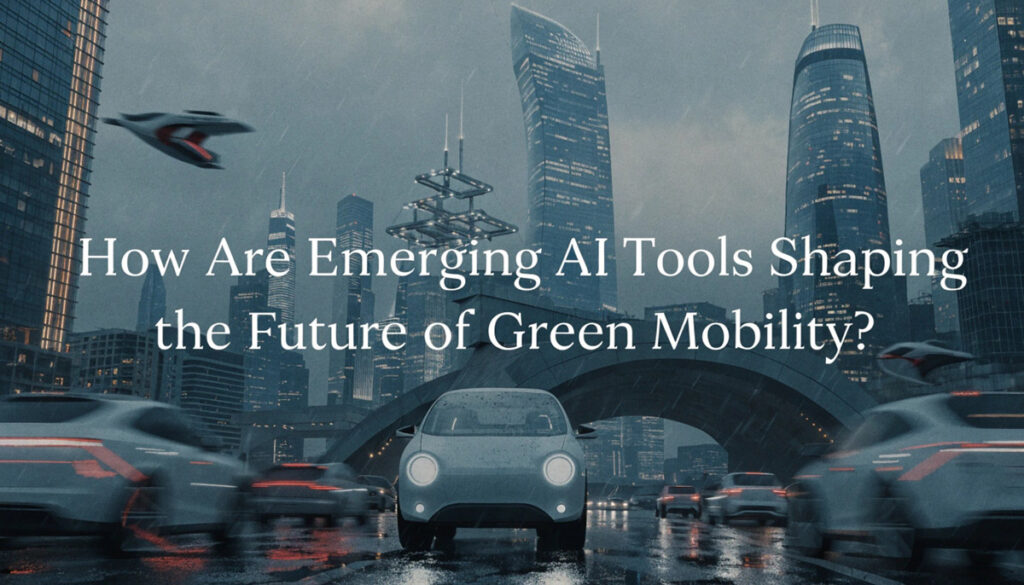
We are witnessing a silent revolution of the roads that we use, our transport systems, and even how cities are being designed to be laid out. It does not entail one dramatic invention, it is more like one thousand little smart decisions that occur at the same time, all those made with the help of artificial intelligence. The general campaign to make transportation cleaner and more sustainable is receiving a serious upgrade in the form of green mobility. And AI is lifting the heavy load.
In This Article:
The Problem With “Going Green” the Old Way
Sustainability in transportation over the years was nothing more than a replacement of one item with another: gas with electricity, old engines with newer ones. Such a strategy worked, but it reached a point.
- You can put electric buses on the road and still put them on routes that are not optimized, making it wasteful to run and annoying to riders.
- You might install charging infrastructure and yet drivers will be scrambling to get at an open one.
It was not just the question of what we were using. It was how we were using it. That is where AI comes in—it is not a substitute to clean technology but the brain to make it actually work.
Smarter Routes, Fewer Emissions
The effect of AI on green mobility has been experienced one of the most direct with regard to route optimization. Logistics companies and transportation agencies are currently implementing machine learning based on:
- Traffic patterns
- Weather conditions
- Passenger counts
- Road quality
These variables help compute the most efficient routes in terms of energy consumption.
Dynamic Optimization in Action
Consider a delivery truck going through a city. Previously, the driver was using a predetermined route of destinations. Nowadays, artificial intelligence can dynamically reroute the same van in real time and save some of the unnecessary miles along with emissions. Optimization alone has been reported to save fuel (or energy) by 10-20% without altering any vehicle in some companies.
In the case of cities, such intelligence is being incorporated into the bus and rail networks. Acceleration and braking in trains are modified on the basis of AI forecasts of platforms. During unpredictable demand variations, buses can be reallocated over a network. What is produced is a leaner, more responsive system that is in reaction to the actual world and not a predetermined one that was planned many months before.
Charging Smarter, Not Just Charging More
The application of electric vehicles is the key to a green mobility future, but it is a real problem to charge them effectively. A grid full of EVs plugging in after the rush hour will be a very serious load and when that load is supplied by fossil fuels during peak time, the environmental advantage will be greatly reduced.
This is being addressed by smart charging systems that are powered by AI by:
- Learning how users act.
- Monitoring the grid and renewable energy levels.
- Scheduling charging sessions with optimal efficiency.
Then at 6 PM your car may be plugged in, but you wait until 2 AM when the wind power is plentiful and no one wants to go to the grid. You get up with a full charge and the grid is not perspiring. This type of invisible optimization is precisely what the large-scale mobility of green should have. It is not glamorous but it works—and it multiplies among millions of cars.
Predictive Maintenance and the Long Game
Durability is one of the aspects of sustainability that one can easily ignore. A car that fails unexpectedly and is scrapped is not a green car, no matter what the powertrain is. Predictive maintenance based on AI is altering the calculus in this case.
EVs, buses, bikes, and trains have sensors that constantly give data to machine learning systems that are capable of detecting the patterns that can predict a breakdown even before it happens.
- Operators of the fleet were warned weeks before.
- Repairs are done at the appropriate time.
- Cars are better lasting, are used more, and produce less waste.
This is transformational to shared mobility services, in the form of think city bike-share programs or electric scooter fleets, in particular. Maintaining such vehicles on the road leads to a direct decrease in the cost of resources on a ride, which makes the entire system more truly sustainable.
Changing How People Move, Not Just What They Move In

Outside the hardware and infrastructure, AI is transforming the human aspect of mobility. Journey planning apps today are now able to propose multimodal trips in real-time—walk 3 minutes, metro, shared e-bike last-mile—using real-time data. They are not only convenient but also designed to push people to the less-emission products without prompting them that they are giving something up.
Even the personal decision-making process has a curious parallel in its transformation by AI in other aspects. Tools like an AI Haircut Visualizer let people preview and explore new looks before committing reducing waste from trial and error visits. This reasoning is similar to mobility where AI will provide human beings with the capability to anticipate smarter decisions, be it a route, a car or a pattern of travel, before making a commitment.
Designing the Cities That Make It All Possible
Green mobility will not occur in a vacuum; it requires the way cities are structured. City planners are now applying AI to simulate the impact of:
- Road design changes
- Parking policy
- Transit frequency on emissions
- Traffic congestion
- Equity in neighborhoods
Other cities are surfacing AI to determine sectors that are under utilized by clean transportation and invest in them first. Some are simulating future infrastructure runaways. It’s a bit like getting an AI Grooming Makeover for your city assessing what’s there, identifying what needs work, and visualizing the improved version before you make any permanent changes. Such planning with data results in superior planning and reduced expensive errors good on budgets and on the planet.
The Road Ahead
What’s exciting about AI and green mobility isn’t any one application—it’s the convergence. There is smarter routing and optimized charging, predictive maintenance, enhanced urban design, and smarter travelers, all getting better at the same time. Every gain accumulates on the other.
We’re not there yet. Inequality in distribution of benefits, real issues on privacy of data, and gaps in infrastructure are real. But the direction is clear. AI is not only making green mobility more efficient; it is making it more practical, more reachable, and capable of working at scale.
That’s not a small thing. That might be everything.